






 Spell
 Quick
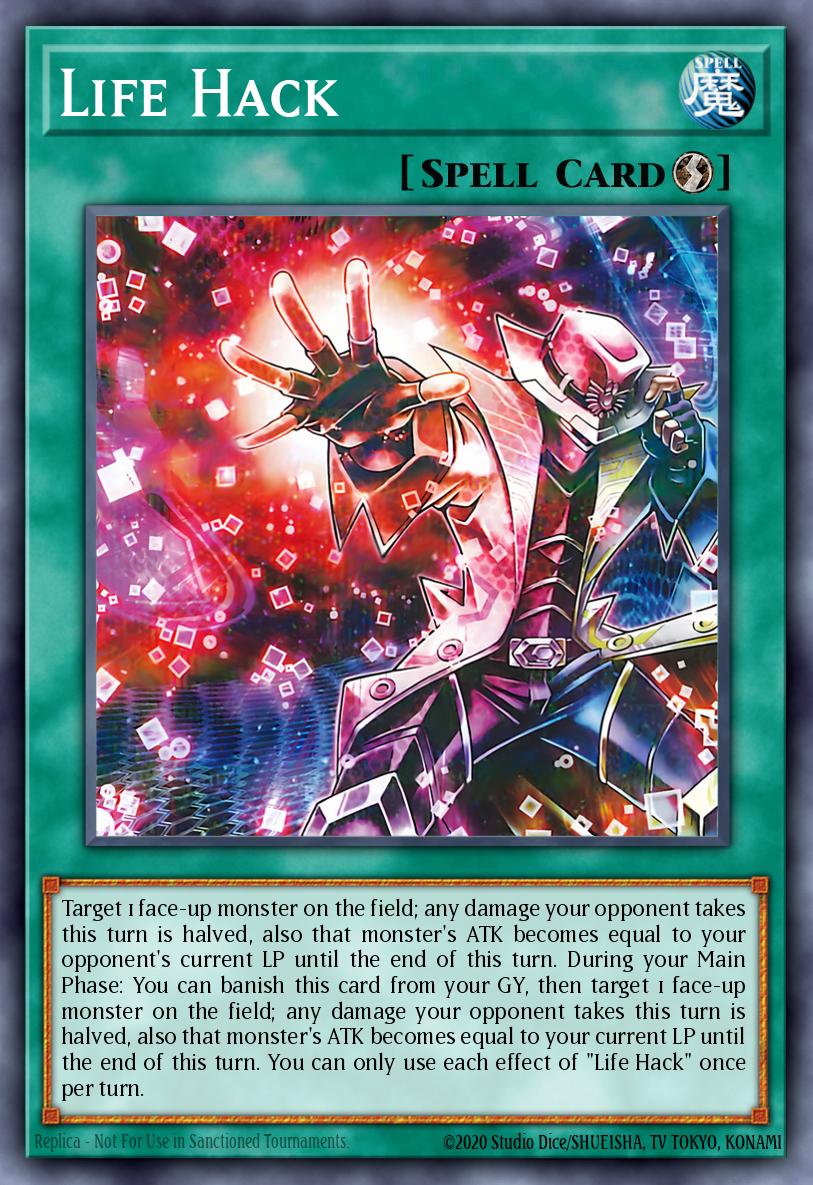
Life Hack
View:
3004
Target 1 face-up monster on the field; any damage your opponent takes this turn is halved, also that monster's ATK becomes equal to your opponent's current LP until the end of this turn. During your Main Phase: You can banish this card from your GY, then target 1 face-up monster on the field; any damage your opponent takes this turn is halved, also that monster's ATK becomes equal to your current LP until the end of this turn. You can only use each effect of "Life Hack" once per turn.
Life Hack — Power Evaluation
Final Score: 54 ± 6 · Confidence: Medium
- Intrinsic: 52 · Deck: 55 · Meta: provisional
- Primary role: Utility · Secondary: Board breaker, Recovery/Recursion
Why it scores here
Life Hack converts one face-up monster into a single combat-tempo tool: its ATK is set to a life total and damage is halved for the turn, with no board-building or card-advantage output. Its real strength is access: a Quick-Play Spell that is recoverable from the GY through its second effect (once per turn per effect), and it sits in 147 recent decks across 56 archetypes at 2.1 copies each. That deck count earned accessibility, portability and deckbuilding cost, but it did not raise the intrinsic score, because frequency is not power (guardrail 3), and no combo data exists to confirm a payoff role.
Axis scores
| Axis | Score | Evidence |
|---|---|---|
| Accessibility | 70 | Quick-Play Spell with a GY-banish second effect gives two activation paths, and 147 of the sampled decks run it at 2.1 copies on average, but no searcher or starter evidence was supplied (observed/inferred). |
| Combo & Conversion | 30 | The text describes a single-monster ATK and damage modification with no board-building step, and combos_evidence has 0 appearances, so conversion is text-only inference (inferred). |
| Resource Economy | 40 | The GY banish cost is a recursion/refuel of the card itself, not card advantage, so resource value is only modest (verified). |
| Effect & Interaction | 35 | No negation or removal is present; the damage-halving only changes combat tempo, and which side it helps depends on reading the targeting text (verified/inferred). |
| Material Utility | 5 | It is a Spell with no material, level or attribute role, so it cannot contribute as a body (verified). |
| Resilience & Flexibility | 60 | Two effects usable from hand and from the GY, each once per turn, give redundancy across zones and turns; no interaction-survival data was supplied (verified/inferred). |
| Deck-Building Efficiency | 80 | It runs at 1 to 3 copies with no garnet or lock, and it appears in 56 archetypes without forcing a build, which is cheap and clean (observed). |
Calculation
Weight profile: Utility / no clear role (default) weights; no secondary blend applied because the role is unclear. Intrinsic ≈ 52, Deck ≈ 55, Meta = provisional. Modifiers: none. Final formula: 0.40*Intrinsic + 0.60*Deck
Strengths
- Live from hand and from the GY, with two once-per-turn effects
- Cheap to run at 1 to 3 copies, with no garnet or lock
- Appears across 56 archetypes (147 decks), so it is portable across homes
- Strong partner support: Harpie's Feather Duster 63.9%, Called by the Grave 48.3%
Weaknesses
- No negation or removal; it only changes combat tempo
- No combo evidence, so combo conversion is text-only
- Damage-halving direction makes the card double-edged and its benefit depends on reading the targeting text
- No material or body value
Counters / choke points
- Opponent monster-effect negation can stop the ATK-setting effect
- Opponent damage-reduction or LP-manipulation lines can shrink the value of the ATK-setting effect
Best use
Utility / combat-tempo tool that recurs from the GY. Decks: Gravekeeper's, Lyrilusc, Resonator, Archfiend, Mikanko. Suggested copies: 2.
Evidence & gaps
- Verified: Card text: two effects, each once per turn, that halve opponent damage this turn and set a face-up monster's ATK to a life total; Recent sample: 147 decks, 56 distinct archetypes, 2.1 average copies, 77.6% in gameplay type 7; No negation, removal or material role in the text
- Observed: Partner frequency: Harpie's Feather Duster in 63.9% of decks, Called by the Grave in 48.3%; Gameplay spread: 77.6% type 7, 16.3% type 4, 6.1% type 6; Usage across many archetypes suggests it is a generic staple, which is not evidence of power
- Inferred: The GY-banish second effect gives a recursion route, so it is available more than once per game; The damage-halving direction could be read either way, which reduces rules reliability; Deck resilience is moderately high because of the number of distinct archetypes
- Data gaps: no combos supplied, so combo conversion is text-only inference no guides supplied no banlist token; assumed 3 copies (unlimited) no usage statistics (StatisticsCard); archetype inclusion is from the deck sample only damage-halving direction and which side benefits are read from text only; no ruling available